
Adolescence is a critical stage of life. It is a period when young people form habits, build social identities, and develop patterns of wellbeing that can shape later health. In recent years, one behaviour has become especially important in public health discussions: vaping.
While cigarette smoking among young people has declined over time, e-cigarette use has become more visible among adolescents. This has raised urgent questions not only about physical health, but also about wellbeing. Are young people who vape, smoke, or do both less satisfied with life than those who do not currently use nicotine?
Our new study, published in Addictive Behaviors, examined life satisfaction across patterns of cigarette and e-cigarette use among adolescents in England.
Life satisfaction across patterns of cigarette and e-cigarette use among adolescents: evidence from a national school-based survey
Read Full Paper →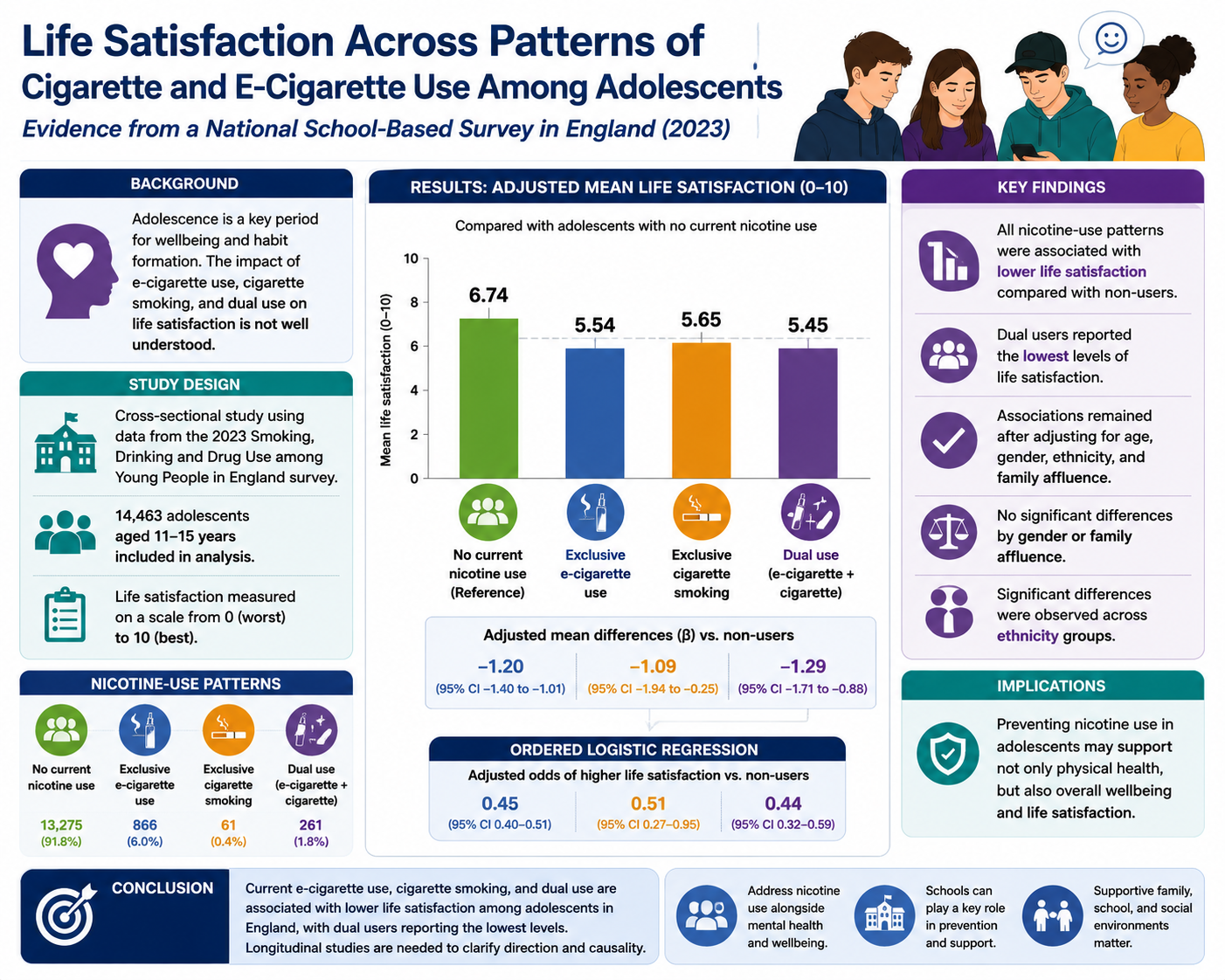
Why this study matters
Most debates about youth vaping focus on addiction, lung health, school behaviour, or future smoking risk. These are important, but they do not tell the full story. Adolescents' subjective wellbeing also matters.
Life satisfaction is a broad measure of how young people evaluate their lives overall. It is not the same as depression or anxiety, but it can reflect emotional, social, and school-related wellbeing. Lower life satisfaction during adolescence may signal broader vulnerability.
Previous studies have linked smoking and substance use with poorer mental health, but less is known about how different patterns of nicotine use relate specifically to life satisfaction. Many studies also combine all nicotine users into one group, which can hide important differences between vaping only, smoking only, and dual use.
What we studied
We analysed data from 14,463 adolescents aged 11 to 15 years who participated in the 2023 Smoking, Drinking and Drug Use among Young People in England survey.
Participants were grouped into four mutually exclusive categories: no current nicotine use, exclusive e-cigarette use, exclusive cigarette smoking, and dual use of both cigarettes and e-cigarettes.
Life satisfaction was measured on a scale from 0 to 10, where higher scores indicated greater satisfaction with life. The analysis adjusted for age, gender, ethnicity, and family affluence.
What we found
Most pupils reported no current nicotine use. However, 6.0% reported exclusive e-cigarette use, 0.4% reported exclusive cigarette smoking, and 1.8% reported dual use.
Compared with adolescents who did not currently use nicotine, all nicotine-use groups reported lower life satisfaction.
After adjustment, predicted mean life satisfaction was 6.74 among non-users. This fell to 5.54 among exclusive e-cigarette users, 5.65 among exclusive cigarette smokers, and 5.45 among dual users.
This means that adolescents who vaped, smoked, or used both products reported meaningfully lower life satisfaction than their peers who did not currently use nicotine. Dual users had the lowest adjusted life satisfaction overall.
The findings were also consistent when life satisfaction was analysed as an ordered outcome. Exclusive e-cigarette users, exclusive cigarette smokers, and dual users all had lower odds of reporting higher life satisfaction compared with non-users.
What the study does not prove
This study does not prove that vaping or smoking causes lower life satisfaction. The data were cross-sectional, meaning nicotine use and life satisfaction were measured at the same time.
There are several possible explanations. Nicotine use may contribute to poorer wellbeing. Alternatively, adolescents with lower life satisfaction may be more likely to start vaping or smoking. It is also possible that both nicotine use and lower life satisfaction reflect shared social, family, peer, school, or mental health factors.
Because of this, the findings should be interpreted as associations, not causal effects.
This study does not prove that vaping or smoking causes lower life satisfaction. Because the data were cross-sectional, the findings should be interpreted as associations, not causal effects.
Why dual use matters
One of the clearest findings was that dual users had the lowest life satisfaction. This group may represent adolescents with greater vulnerability, stronger nicotine dependence, or more complex social and behavioural risk factors.
For schools, parents, clinicians, and public health professionals, this matters. Young people who both smoke and vape may need more support than a simple warning about nicotine. Their nicotine use may be a visible sign of broader wellbeing challenges.
What this means for public health
The findings suggest that youth vaping should not be viewed only as a product-use issue. It is also linked with adolescent wellbeing. Prevention strategies should therefore connect nicotine education with broader support for young people's mental, emotional, and social lives.
Schools and youth services should address vaping and smoking together, while also asking why young people are using these products. Are they stressed? Are they influenced by peers? Are they using nicotine to cope? Are they experiencing low confidence, poor school connectedness, or family difficulties?
Bottom line
In this national study of adolescents in England, current vaping, smoking, and dual use were all associated with lower life satisfaction. Dual users reported the lowest levels of life satisfaction. Although the study cannot prove cause and effect, it highlights an important public health message: adolescent nicotine use is closely connected with poorer subjective wellbeing.
Reducing youth nicotine use should therefore be part of a wider strategy to support adolescent health, confidence, resilience, and life satisfaction.

Comments
Loading comments...
Leave a Comment
Share your thoughts on this article.