
Oral health is more than having clean teeth. Problems with the mouth, gums, teeth, or saliva can affect eating, speaking, confidence, comfort, and overall quality of life. Cigarette smoking has long been recognised as a major risk factor for poor oral health, but the oral health implications of e-cigarette use and dual use remain less clear. Our new population-based study, published in Oral Diseases, examined how combustible cigarette smoking, e-cigarette use, and dual use were associated with self-reported oral health outcomes among adults in England.
Heterogeneous Oral Health Outcomes by Combustible Cigarette Smoking, E-Cigarette Use and Dual Use: A Cross-Sectional Population-Based Analysis
Read Full Paper →Why this study matters
E-cigarettes are now widely used, particularly among people who smoke or previously smoked cigarettes. While vaping removes exposure to many toxicants produced by tobacco combustion, it does not automatically mean that e-cigarettes are neutral for oral health. At the same time, many adults who vape have a history of smoking, which makes it difficult to separate possible vaping-related effects from the long-term damage caused by previous cigarette use.
This is one of the key challenges in research on vaping and oral health: are poorer outcomes among vapers caused by e-cigarettes themselves, or do they partly reflect the lingering effects of past smoking?
What we studied
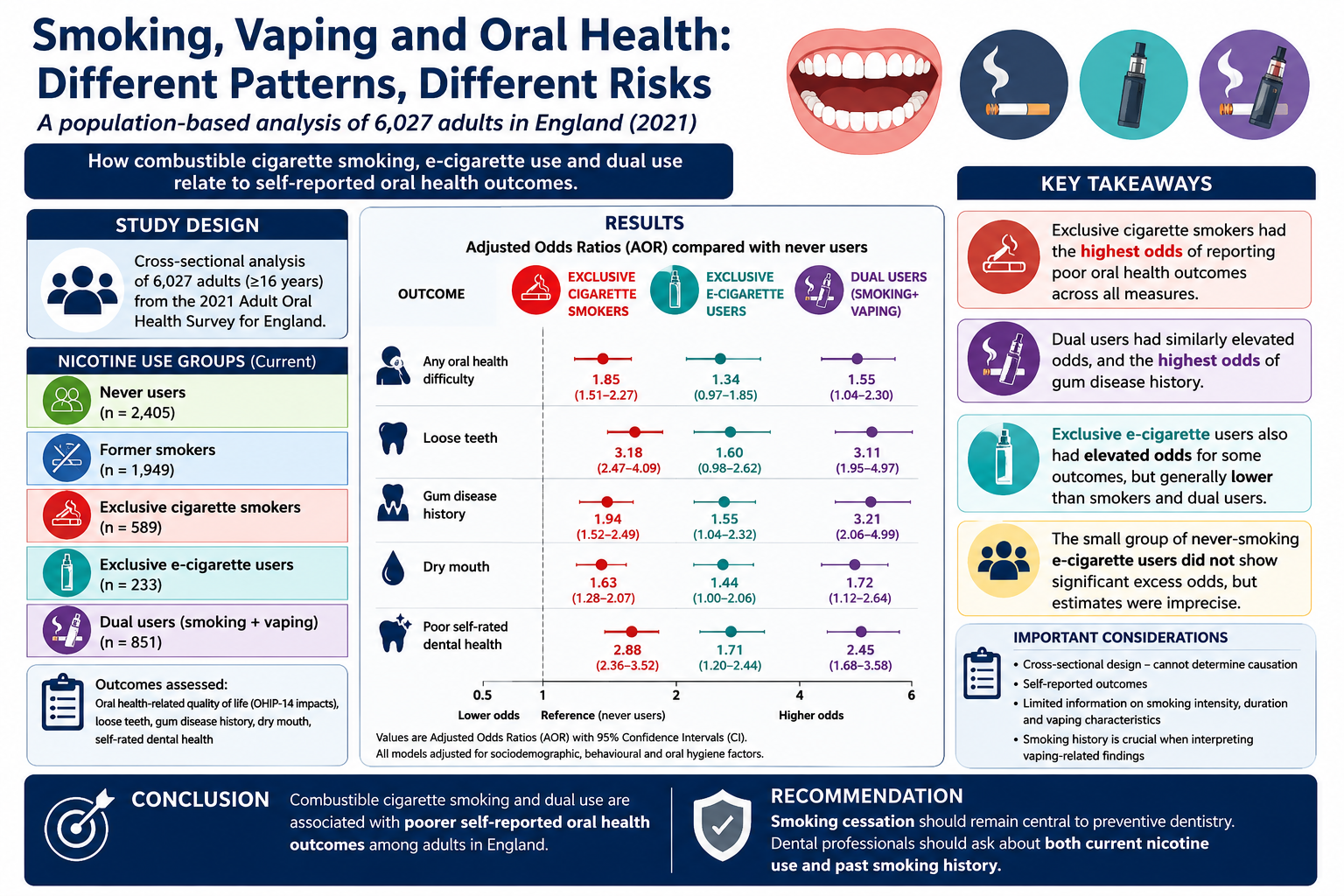
We analysed data from 6,027 adults aged 16 years and above who participated in the nationally representative 2021 Adult Oral Health Survey for England. Participants were grouped by current nicotine use: never users, former smokers, exclusive cigarette smokers, exclusive e-cigarette users, and dual users who both smoked and vaped. We also examined vaping history separately, distinguishing current e-cigarette users who had never smoked from those with a smoking history.
The study assessed several oral health outcomes, including oral health-related quality of life, loose teeth, gum disease history, dry mouth, and self-rated dental health. The analyses adjusted for factors such as age, sex, ethnicity, deprivation, alcohol use, smokeless tobacco use, dental attendance, toothbrushing frequency, and fluoride toothpaste use.
What we found
The clearest pattern was that combustible cigarette smoking and dual use were associated with poorer oral health outcomes. Compared with never users, exclusive cigarette smokers had higher odds of reporting oral health difficulties, loose teeth, gum disease history, dry mouth, and poorer self-rated dental health. Dual users also showed elevated odds across several outcomes and had the highest odds of reporting a history of gum disease.
Exclusive e-cigarette users also showed higher odds of some adverse oral health outcomes compared with never users. However, this finding needs careful interpretation because most e-cigarette users in the sample had previously smoked cigarettes. This means that some of the observed oral health burden among vapers may reflect past smoking rather than vaping itself.
Importantly, the subgroup of current e-cigarette users who had never smoked was very small. Because of this, the estimates for never-smoking vapers were imprecise and should be treated as exploratory, not definitive.
What the findings do not mean
This study does not prove that vaping causes poor oral health. The study was cross-sectional, meaning exposure and outcome were measured at the same time. It cannot establish whether smoking or vaping came before oral health problems.
The study also relied on self-reported oral health outcomes rather than clinical dental examinations. It did not include detailed information on smoking intensity, pack-years, time since quitting, vaping duration, device type, nicotine concentration, or product composition. For these reasons, the results should be interpreted as associations, not proof of cause and effect.
Why smoking history matters
One of the most important messages from this study is that smoking history should not be ignored in vaping research. Combining all e-cigarette users into one group can make it look as though vaping itself is responsible for oral health problems, when some of the risk may actually reflect previous cigarette smoking.
Future studies should separate never-smoker vapers, former-smoker vapers, dual users, and exclusive smokers. This distinction is essential for understanding the real oral health risks linked to different nicotine use patterns.
Bottom line
This study adds important evidence to the debate on smoking, vaping, dual use, and oral health. Combustible cigarette smoking and dual use were consistently associated with poorer self-reported oral health among adults in England. Findings for exclusive e-cigarette users require caution because most had a history of smoking, and the number of never-smoking vapers was too small for firm conclusions.
For dental practice and public health, the message is clear: smoking cessation should remain central to oral disease prevention, and dental professionals should record both current nicotine use and past smoking history when assessing oral health risk.

Comments
Loading comments...
Leave a Comment
Share your thoughts on this article.