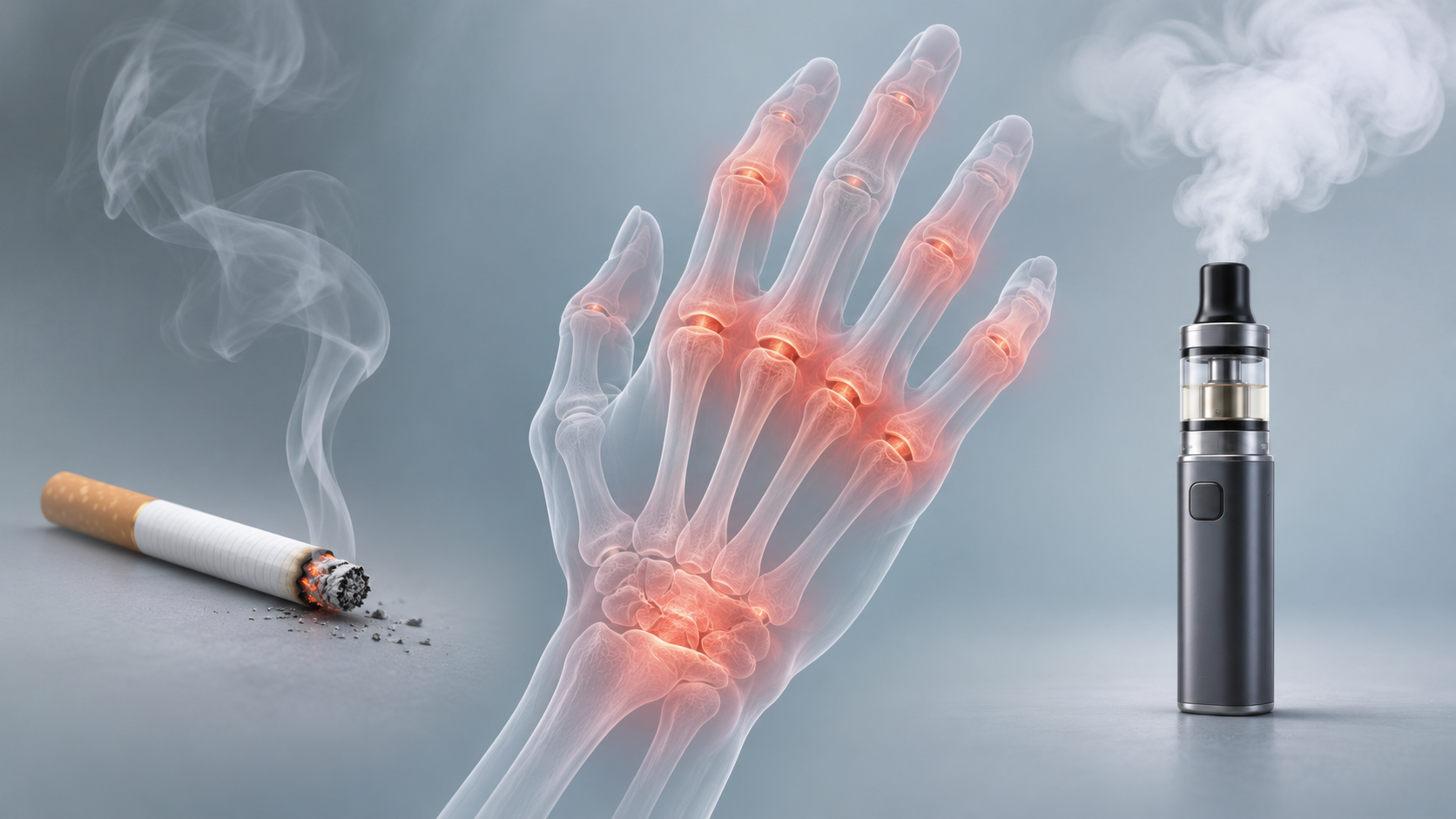
Does smoking increase your risk of developing arthritis? And what about vaping? As more people turn to e-cigarettes as an alternative to smoking, understanding their potential long-term health effects has become increasingly important.
Cigarette smoking is already an established risk factor for rheumatoid arthritis. However, evidence on vaping and arthritis remains limited, particularly from studies that follow people over time.
In our new study, published on 19 November 2026 in Clinical Rheumatology, we examined whether cigarette smoking, exclusive e-cigarette use, and using both products were associated with newly diagnosed arthritis among UK adults.
Associations of cigarette smoking, e-cigarette use, and dual use with newly diagnosed arthritis: a longitudinal cohort analysis
Read Full Paper →How was the study conducted?
We analysed data from 18,802 adults participating in Understanding Society, the UK Household Longitudinal Study.
All participants were free from self-reported arthritis at the start of the study in 2018–2019. We classified them into four groups:
- People who currently used neither cigarettes nor e-cigarettes.
- People who smoked cigarettes exclusively.
- People who used e-cigarettes exclusively.
- People who both smoked cigarettes and used e-cigarettes (dual users).
We then examined newly diagnosed arthritis reported at the 2022–2023 follow-up interview.
Our analysis accounted for several factors that could influence arthritis risk, including age, sex, ethnicity, education, and rural or urban residence.
What did we find about smoking, vaping and arthritis risk?
Overall, 587 participants (3.1%) reported newly diagnosed arthritis at follow-up.
Compared with participants who currently used neither cigarettes nor e-cigarettes, we found that:
- Exclusive cigarette smokers had a 43% higher adjusted risk of reporting newly diagnosed arthritis (RR 1.43; 95% CI 1.11–1.84).
- Dual users had a 79% higher adjusted risk (RR 1.79; 95% CI 1.10–2.90).
- Exclusive e-cigarette users showed no statistically significant association with newly diagnosed arthritis (RR 1.01; 95% CI 0.61–1.68).
Risk ratios compared with people who currently used neither cigarettes nor e-cigarettes, adjusted for age, sex, ethnicity, education, and rural or urban residence. These are associations, not proof of cause and effect.
The association with cigarette smoking remained consistent across additional analyses.
For dual users, however, the association weakened and became less precise when vaping was restricted to at least monthly or weekly use. This suggests that the dual-use finding requires further investigation.
Importantly, these results describe associations, not proof that smoking or vaping directly caused arthritis.
Does vaping cause arthritis?
Our study did not find evidence of an association between exclusive vaping and newly diagnosed arthritis. However, this should not be interpreted as proof that vaping carries no arthritis risk.
Only 15 exclusive e-cigarette users reported newly diagnosed arthritis in our main analysis. Consequently, the estimate was relatively imprecise, and we cannot rule out a potentially important association.
There were also limitations. Cigarette and e-cigarette use were assessed at baseline, meaning we could not fully account for changes in use during follow-up. We also lacked detailed cumulative smoking histories and body mass index information, while arthritis diagnoses were self-reported rather than clinically verified.
Further research with larger samples, repeated exposure measurements, and medically confirmed arthritis diagnoses is needed.
What do these findings mean for people who smoke or vape?
Our findings add to existing evidence linking cigarette smoking with arthritis, while providing new longitudinal evidence on exclusive vaping and dual use.
For people who smoke, quitting cigarettes completely remains an important step towards improving health. Those who are unable or unwilling to quit nicotine may consider switching completely to vaping, which is generally considered less harmful than continuing to smoke. However, vaping is not risk-free, and our study did not directly establish its relative safety for arthritis.
Using cigarettes and e-cigarettes together should not automatically be assumed to reduce arthritis risk.
For people who do not smoke, this research is certainly not a reason to start vaping.
Final thoughts
Our study found higher adjusted risks of newly diagnosed arthritis among cigarette smokers and dual users, but no clear association among exclusive e-cigarette users.
These findings contribute to an emerging evidence base on vaping and long-term health outcomes. They also highlight why distinguishing exclusive vaping from dual use, while accounting for smoking history, is essential when investigating the potential health effects of nicotine products.
Read the full open-access study:
Adebisi YA, Alhur AA, Ogunkola IO, et al. (2026). Associations of cigarette smoking, e-cigarette use, and dual use with newly diagnosed arthritis: a longitudinal cohort analysis. Clinical Rheumatology. https://doi.org/10.1007/s10067-026-08544-7

Comments
Loading comments...
Leave a Comment
Share your thoughts on this article.