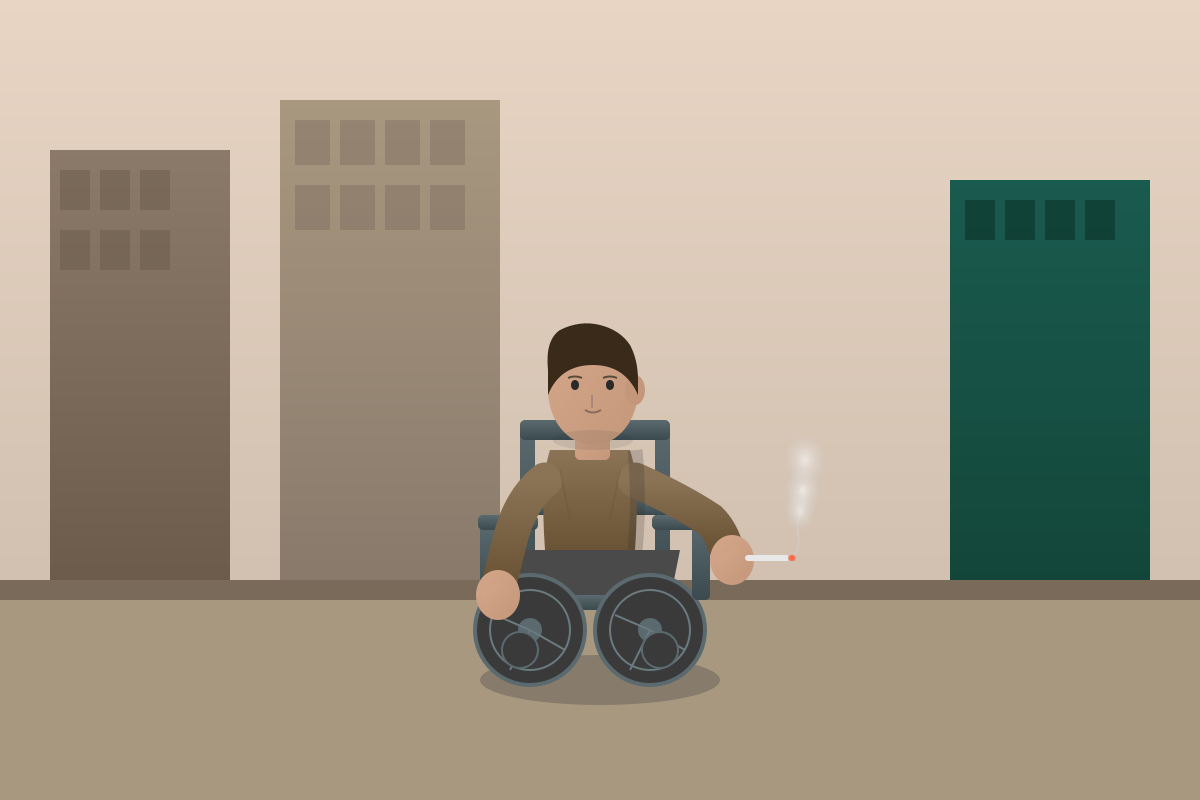
Tobacco smoking remains one of the leading causes of preventable illness and premature mortality in the United Kingdom. Yet smoking is not evenly distributed across the population. Longstanding evidence shows that people living with disabilities experience higher smoking prevalence than non-disabled adults.
What has been less clear is whether this inequality changed during the COVID-19 pandemic — a period that reshaped health behaviours, access to care, and social stressors across society.
In our recent study published in the European Journal of Public Health, we set out to examine this question using nationally representative data from the UK Annual Population Survey, covering the period 2017 to 2023. The analysis included over 1.08 million adults, making it one of the largest population-level examinations of smoking disparities by disability status conducted in the UK to date.
Tobacco smoking by disability status before and after COVID-19 onset: a repeated cross-sectional analysis of 1 087 678 adults
Read Full Paper →We classified smoking status into three categories: current smoker, ex-smoker, and never smoker. Disability status was defined in line with the Equality Act, ensuring consistency with UK policy frameworks. Using multinomial logistic regression models, we estimated adjusted relative risk ratios comparing smoking outcomes between disabled and non-disabled adults, while accounting for key sociodemographic factors such as age, sex, education, ethnicity, marital status, and region.
The findings were clear and consistent.
Across all survey years combined, disabled adults were significantly more likely to smoke. After adjustment, they had 78% higher relative risk of being current smokers compared with never smokers, and a 44% higher risk of being ex-smokers. This pattern reflects both higher uptake historically and ongoing challenges in cessation.
We then examined whether the pandemic altered this relationship. Stratified analyses suggested that disparities widened: adjusted relative risk ratios for current smoking increased from 1.65 before the pandemic (2017–2019) to 1.95 after its onset (2020–2023).
However, stratified comparisons alone cannot separate pandemic effects from pre-existing trends. To address this, we fitted a joint model incorporating survey year (to account for temporal trends) and a post-2020 pandemic indicator, alongside an interaction term.
This more rigorous analysis told a more nuanced story.
After accounting for underlying trends, the pandemic itself did not independently change the association between disability and smoking. The interaction term was not statistically significant. In other words, smoking inequalities did not suddenly emerge or sharply worsen because of COVID-19 — they were already entrenched.
That said, absolute inequalities remained substantial. Adjusted marginal effects showed that disabled adults had a 5.63 percentage-point higher probability of smoking before the pandemic and a 4.60-point higher probability after. This represents only a modest narrowing of the gap.
The policy implications are significant.
First, disability-related smoking inequalities are persistent, large, and structurally embedded. Second, broad population tobacco control policies, while effective overall, may not adequately reach or support disabled communities. Barriers can include poverty, mental health burdens, social isolation, targeted tobacco marketing, and reduced access to tailored cessation services.
Addressing these disparities requires disability-inclusive tobacco control strategies. This includes accessible cessation programmes, integration of smoking support within disability and social care services, and policy design that accounts for intersecting vulnerabilities.
Health equity cannot be achieved if major population groups remain underserved.
As the UK advances toward smokefree ambitions, closing the disability smoking gap must be treated not as a peripheral issue, but as a central public health priority.
Because progress is only meaningful when it reaches everyone.

Comments
Loading comments...
Leave a Comment
Share your thoughts on this article.