When people think about the health risks of smoking, conditions such as lung cancer, heart disease and chronic respiratory disease usually come to mind. But could smoking also be linked to infections that are harder to treat with antibiotics?
This question is particularly important as antibiotic resistance continues to threaten global health. When bacteria become resistant to antibiotics, infections can become more difficult to treat, sometimes requiring alternative medicines or longer treatment.
In our systematic review and meta-analysis, published in Frontiers in Public Health on 7 October 2026, we examined whether tobacco smoking history was associated with antibiotic-resistant infections.
Our findings suggest that smoking may be an important, but often overlooked, factor in understanding the burden of antibiotic resistance.
Tobacco smoking history and antibiotic-resistant infection: a systematic review and meta-analysis
Read Full Paper →What did our research examine?
We reviewed 43 observational studies involving more than 35,000 participants from different countries.
The studies compared people who currently smoked or had smoked previously with those who had never smoked, examining their likelihood of having antibiotic-resistant infections.
Most studies focused on drug-resistant tuberculosis (TB), an infectious disease that primarily affects the lungs. Other studies examined resistant bacterial infections involving organisms such as Staphylococcus aureus, Streptococcus pneumoniae and Escherichia coli.
By combining the available evidence, we aimed to establish whether a consistent association existed between smoking history and antibiotic-resistant infection.
What did we find?
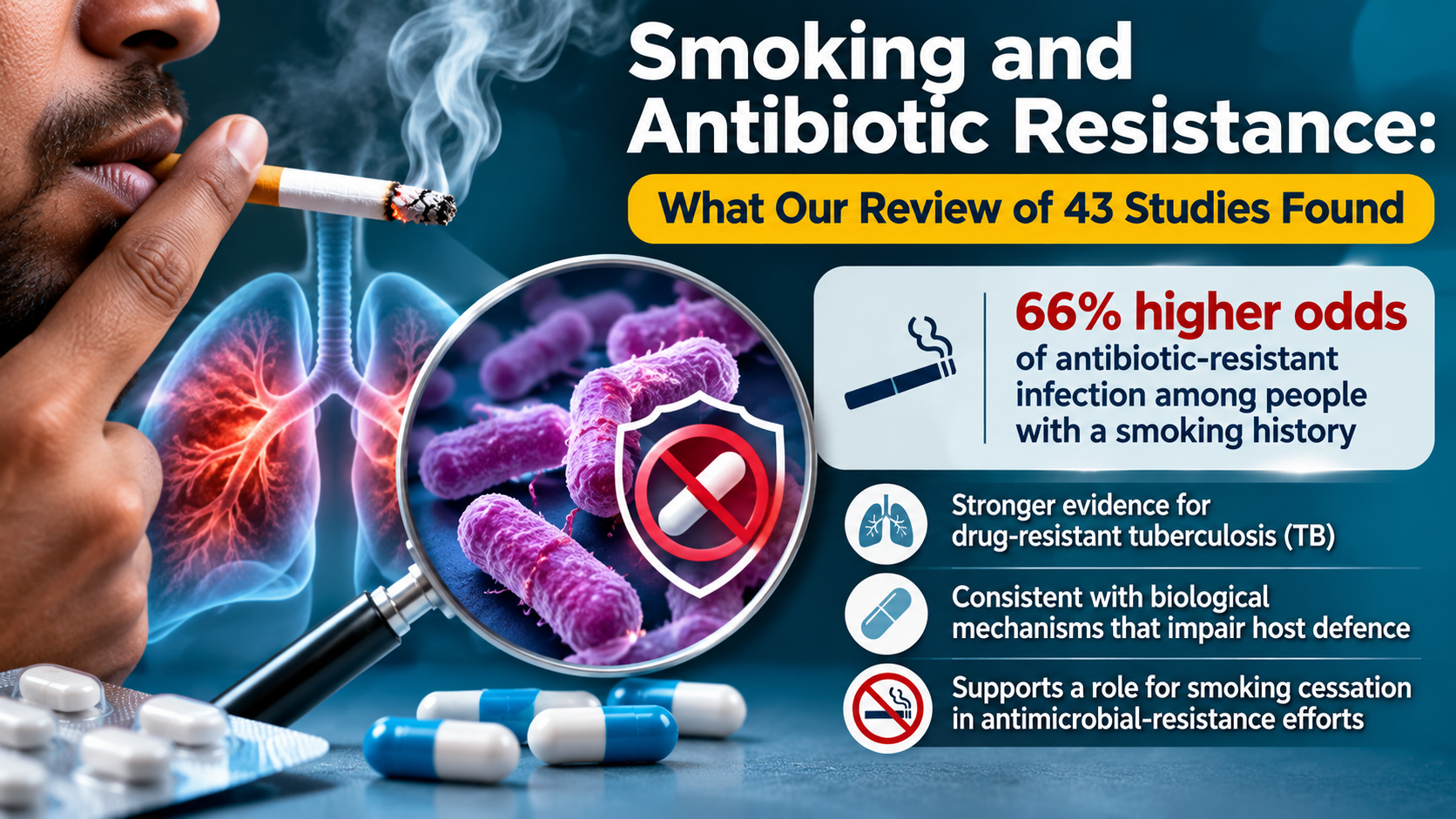
Our main analysis found that people with a history of smoking had 66% higher odds of antibiotic-resistant infection compared with never smokers.
The pooled odds ratio was 1.66 (95% confidence interval 1.33–2.07).
We also found differences when examining smoking status separately:
- Current smokers: 90% higher odds of antibiotic-resistant infection compared with never smokers.
- Ever smokers: 48% higher odds compared with never smokers.
- Drug-resistant tuberculosis: Smoking history was associated with 58% higher odds.
Based on 43 observational studies with more than 35,000 participants. These are associations, not proof that smoking causes antibiotic resistance.
When we restricted the analysis to studies reporting adjusted estimates, the association remained, with approximately twice the odds of resistant infection among people with a smoking history.
These findings were reasonably consistent across several analyses. However, the studies differed substantially, and the results should not be interpreted as evidence that smoking directly causes antibiotic resistance.
Does smoking cause antibiotic resistance?
Our study identified an association, but it cannot establish causation.
Antibiotic resistance develops when bacteria acquire or possess mechanisms that allow them to survive antibiotic treatment. Smoking does not necessarily cause this process directly.
However, several biological pathways could help explain the association.
Cigarette smoke damages the respiratory tract and interferes with the body's normal defence mechanisms. It can impair immune cells responsible for identifying and removing bacteria, potentially increasing susceptibility to infection or allowing infections to persist.
Persistent infections may require repeated or prolonged antibiotic treatment, potentially creating additional opportunities for resistant bacteria to be selected.
Smoking may also influence the composition of microbial communities in the respiratory tract.
Importantly, these explanations are biologically plausible mechanisms rather than pathways demonstrated by our meta-analysis.
Why is the finding particularly important for tuberculosis?
Tuberculosis accounted for 39 of the 43 studies included in our review.
This means our findings are especially relevant to drug-resistant TB, including multidrug-resistant tuberculosis, which is considerably more challenging to treat than drug-susceptible disease.
Smoking is already recognised as an important factor in tuberculosis infection and disease outcomes. Our findings add evidence of an association with drug-resistant TB.
For other antibiotic-resistant infections, the evidence remains limited. Only four studies examined resistance outside tuberculosis, so we cannot confidently generalise our findings to all bacterial infections.
What does this mean for public health?
Efforts to address antibiotic resistance commonly focus on improving antibiotic prescribing, preventing infections, strengthening laboratory diagnostics and monitoring resistant organisms.
These measures remain essential. However, our findings suggest that tobacco smoking deserves greater attention within discussions about antibiotic-resistant infections.
One practical consideration is integrating smoking-cessation support into tuberculosis treatment programmes, particularly in settings where both tobacco use and drug-resistant TB are important public health concerns.
Helping people stop smoking offers established health benefits. Whether it can also reduce antibiotic-resistant infections specifically requires further research.
Final thoughts
Our review adds to the growing evidence that smoking affects health beyond its well-known associations with cancer, cardiovascular disease and respiratory illness.
The association between smoking history and antibiotic-resistant infection deserves attention, particularly in tuberculosis care.
Nevertheless, most included studies were observational, differences between studies were substantial, and several important factors could not be fully accounted for.
More prospective research is needed to determine whether smoking cessation can reduce the likelihood of antibiotic-resistant infections.
Read our open-access research paper:
Adebisi YA, Bamisaiye A. (2026). Tobacco smoking history and antibiotic-resistant infection: a systematic review and meta-analysis. Frontiers in Public Health, 14:1935025. https://doi.org/10.3389/fpubh.2026.1935025

Comments
Loading comments...
Leave a Comment
Share your thoughts on this article.