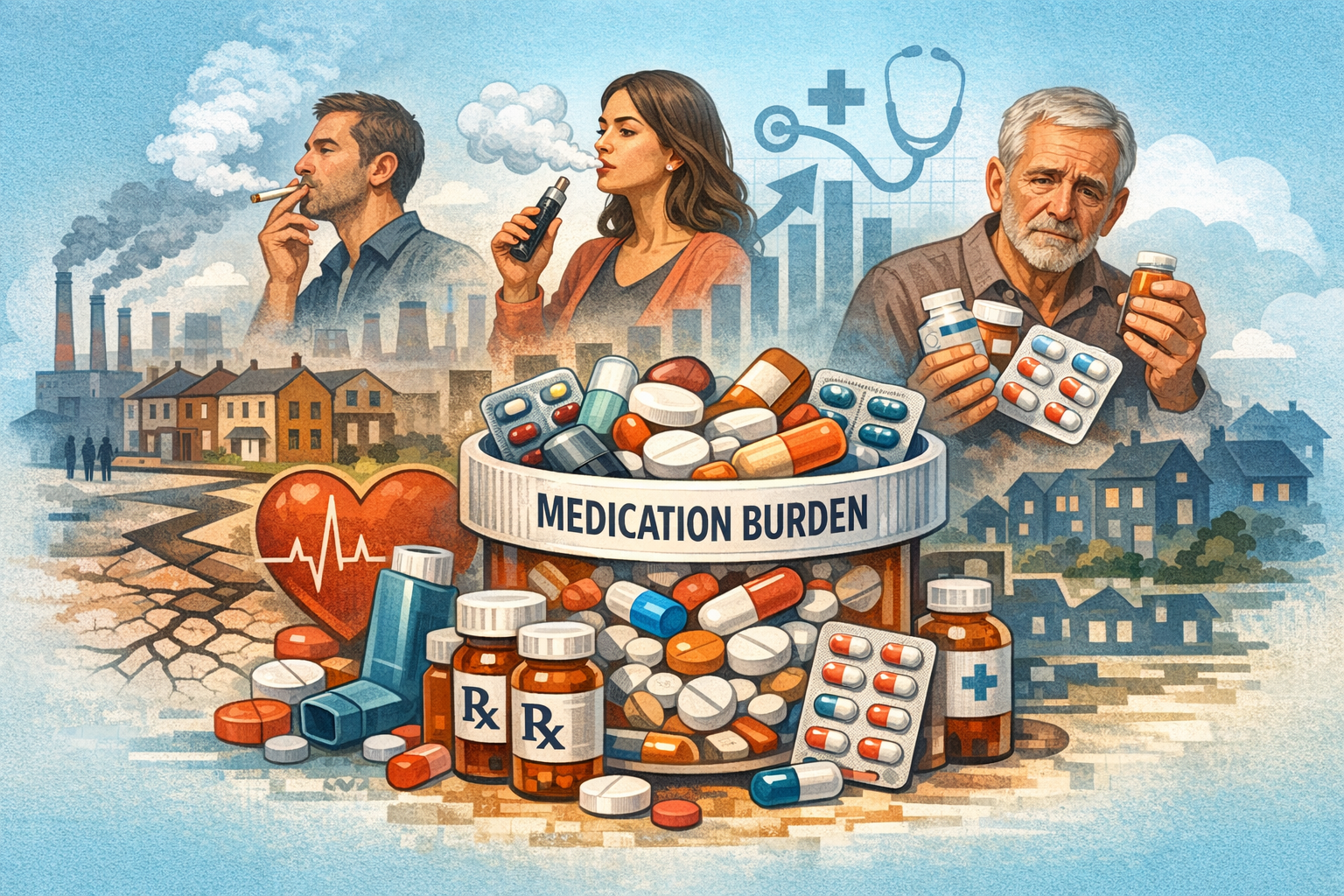
I am pleased to share that I have just published a new open-access study in Health Science Reports examining how prescribed medication burden varies by smoking and e-cigarette use status in England. The question behind the study is simple but important. Do people who smoke, vape, or used to smoke differ in the number and type of medicines they are prescribed, and what might that tell us about longer-term health needs?
Prescribed Medication Burden by Tobacco Smoking and E-Cigarette Use Status
Read Full Paper →Why medication burden matters
Medication burden refers to the number of prescribed medicines a person is taking. It is more than a prescribing statistic. At a population level, it can act as a marker of chronic disease, healthcare use, and treatment complexity. Higher medication burden is often linked to adherence challenges, drug interactions, and greater pressure on health services.
Using data from 1,657 adults in the Health Survey for England 2021 who completed a nurse visit, our study compared four mutually exclusive groups: never users, current smokers, current exclusive e-cigarette users, and ex-smokers. We looked at both overall medication burden and prescriptions across major treatment categories, including cardiovascular, respiratory, metabolic, gastrointestinal, mental health, pain and anti-inflammatory, and anti-infective medicines.
The clearest finding: ex-smokers carried the highest burden
The most striking result was that ex-smokers had the highest overall medication burden. One in five ex-smokers (20.3%) were taking three or more prescribed medicines, compared with 8.6% of never users, 10.9% of current smokers, and 12.2% of current exclusive e-cigarette users. After adjustment for age, sex, education, and area-level deprivation, ex-smokers still had significantly higher odds of being in a higher medication burden category than never users.
They also had significantly higher odds of using respiratory, gastrointestinal, and anti-infective medicines. This matters because it suggests that the health consequences of smoking may continue to shape prescribing even after smoking cessation. At the same time, this finding should be interpreted carefully. Some people may stop smoking because they become ill and begin treatment, so reverse causation is also plausible.
The health consequences of smoking may continue to shape prescribing even after smoking cessation.
E-cigarette users showed a different pattern
Current exclusive e-cigarette users did not have significantly higher overall medication burden than never users, although there was a non-significant trend in that direction. What stood out instead was pain and anti-inflammatory medication use. Compared with never users, exclusive e-cigarette users had markedly higher odds of using these medicines.
This does not mean vaping itself caused that prescribing pattern. In fact, almost all exclusive e-cigarette users in the sample were former smokers, and most had previously smoked regularly. That suggests their medication profile may still reflect the legacy of earlier smoking rather than a clear independent effect of vaping.
What this adds
One reason I think this study matters is that it moves beyond disease-specific outcomes and looks at medication burden as a broader indicator of healthcare demand. The findings reinforce the long shadow of tobacco use, highlight the need to monitor prescribing patterns among people who switch to e-cigarettes, and show why early smoking prevention and cessation remain essential for reducing long-term treatment burden.

Comments
Loading comments...
Leave a Comment
Share your thoughts on this article.