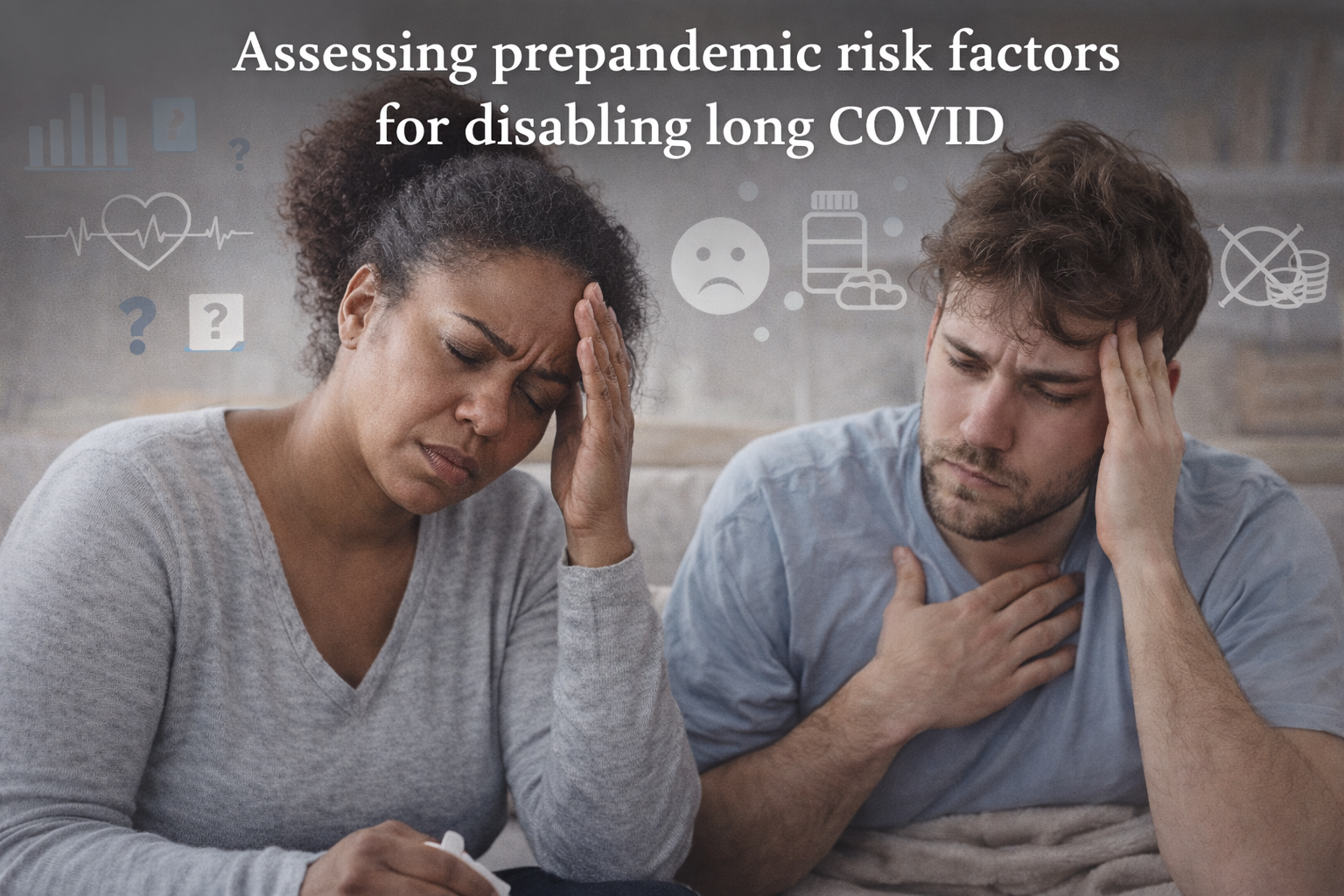
Long COVID is no longer a new story, but one question has been surprisingly hard to answer: who was most vulnerable before the virus ever arrived? Most of what we know about long COVID comes from clinical cohorts or surveys run after infection, which makes it difficult to untangle cause from consequence. Was someone distressed because they had long COVID, or did distress come first? A new paper, just published in the Journal of Tropical Medicine, takes a different approach — and the findings matter for how we think about recovery, disability and health inequality.
Prepandemic Risk Factors for Disabling Long COVID: A Prospective Cohort Analysis
Read Full Paper →Looking backwards from the pandemic
The study used data from the UK Household Longitudinal Study (Understanding Society), a large nationally representative survey that has followed the same people across years. By linking Wave 10 (2018–19) — collected well before anyone had heard of SARS-CoV-2 — to Wave 14 (2022–23), it was possible to identify characteristics that existed before infection and see which ones predicted disabling long COVID later on.
The analytic sample included 12,033 adults who reported a positive COVID-19 test at follow-up. The focus was specifically on disabling long COVID, defined as symptoms lasting more than 12 weeks that limited day-to-day activities — not just lingering symptoms, but symptoms serious enough to interfere with life. Around 5.7% of the sample met that threshold.
What the study found
Several prepandemic factors independently predicted who went on to develop disabling long COVID:
- Women were more affected than men (26% higher risk).
- Middle-aged adults (30–69) were at higher risk than those aged 16–29.
- Pre-existing health conditions and poor self-rated health were strong predictors — fair or poor self-rated health raised risk by nearly 80%.
- Psychological distress measured before the pandemic increased risk by 44%.
- Poor sleep quality nearly doubled the risk, even after adjusting for everything else.
- Low income satisfaction was associated with higher risk, while moderate and high satisfaction were protective.
Fatigue, muscle aches, breathlessness, headaches and persistent cough were the most commonly reported symptoms among those with disabling long COVID.
Men and women look different
One of the more interesting findings came from splitting the analysis by sex. The risk profile was not the same for men and women:
- Living in a rural area increased risk — but only for women.
- Moderate income satisfaction was protective — but only for women.
- Being 70 or older was protective — but only for women.
- Among men, middle age and poor sleep stood out most.
These are not small statistical quirks. They suggest that the pathways leading to disabling long COVID are shaped by social roles, caregiving responsibilities and healthcare access in ways that differ by sex. Pooled estimates that lump everyone together risk hiding exactly this kind of pattern.
Vulnerability to long-term illness is built up over a lifetime, not created overnight by a virus.
Why this matters
The field has spent a lot of energy counting long COVID symptoms. That is important, but it misses something. Not every person with persistent symptoms loses the ability to work, care for family or participate in daily life. Distinguishing disabling from non-disabling long COVID is essential if we want to allocate healthcare, disability support and workplace accommodation fairly.
The findings also push against the idea that long COVID is purely a post-viral biological story. Prepandemic mental health, sleep, finances and chronic illness were already shaping who would struggle most — years before anyone was infected. Vulnerability to long-term illness is built up over a lifetime, not created overnight by a virus.
Caveats
This is observational work with real limits. Infection and long COVID were self-reported, vaccination status or severity of initial infection could not be adjusted for, and “disabling” was measured as a binary rather than a spectrum. The estimates are treated as adjusted associations, not causal effects. But the prospective design — predictors locked in before the pandemic — gives more confidence than most retrospective studies can offer.
The bigger picture
If we are serious about pandemic recovery, we need to take the social and health inequalities that predated COVID-19 as seriously as the virus itself. Disabling long COVID is not falling on people at random. It is following the fault lines that were already there.

Comments
Loading comments...
Leave a Comment
Share your thoughts on this article.