
Cigarette smoking exposes people to a complex mixture of toxic chemicals produced during tobacco combustion. But what happens when someone stops smoking conventional cigarettes and switches completely to electronic cigarettes? Does their exposure to these chemicals fall, and by how much?
In our newly published systematic review and meta-analysis in Archives of Toxicology, my colleagues and I examined human biomarker evidence to better understand the changes associated with complete switching from combustible cigarettes to e-cigarettes.
Changes in human biomarkers of exposure after complete switching from cigarettes to e-cigarettes or exclusive e-cigarette use: a systematic review and biomarker-specific meta-analysis
Read Full Paper →Looking beyond self-reported smoking behaviour
Rather than relying solely on self-reported smoking or vaping behaviour, we focused on biomarkers: measurable substances in blood, urine or breath that indicate exposure to particular chemicals. These measures offer insight into the toxicants people absorb.
We searched PubMed, Scopus and Web of Science through 28 May 2026 and included 60 human studies. These covered clinical switching experiments, observational comparisons and studies tracking changes in tobacco-product use over time.
For the quantitative analysis, we focused specifically on complete switching from cigarettes to e-cigarettes, or exclusive e-cigarette use after cigarette smoking. Six publications, representing seven study-level sources, contributed 47 effects across ten exposure biomarkers. Studies of people who continued smoking while vaping were examined separately.
What did we find?
The central finding was consistent: every biomarker included in the meta-analysis was lower after complete switching or exclusive e-cigarette use than under baseline or reference cigarette-smoking conditions.
Pooled estimates from six publications (seven study-level sources) contributing 47 effects across ten biomarkers of exposure. These describe changes in measured exposure, not equivalent reductions in disease risk.
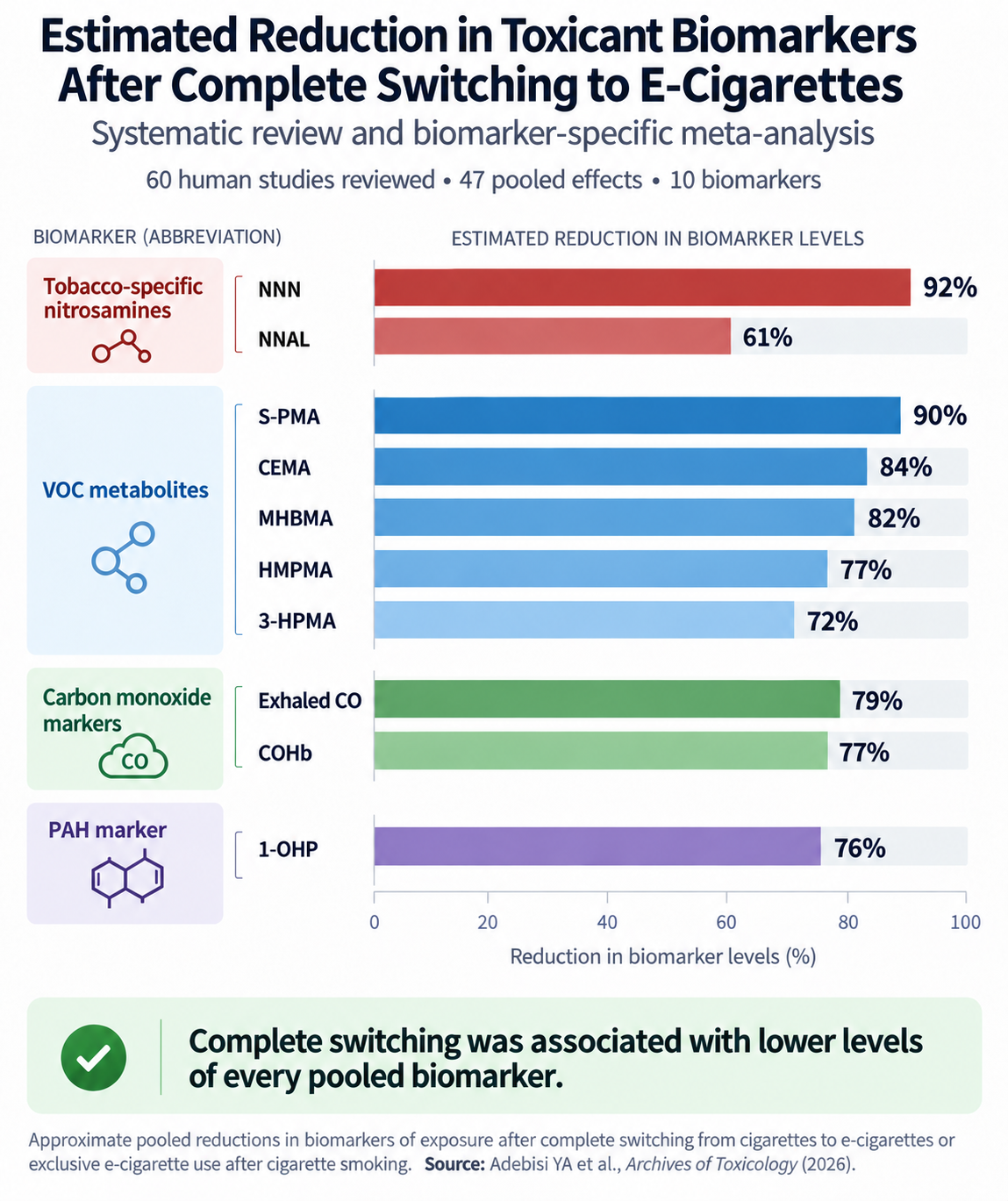
These are pooled estimates across studies, not guaranteed reductions for any individual who switches. They describe changes in measured exposure, not equivalent percentage reductions in cancer, cardiovascular disease or other health risks.
An additional finding was that nicotine exposure was generally maintained or declined less than the non-nicotine toxicant biomarkers. This helps explain why switching nicotine delivery away from combustion can substantially alter a person’s chemical exposure profile.
Why complete switching matters
An important message concerns people who both smoke and vape.
Across the wider evidence, dual use generally produced smaller and more variable reductions than exclusive vaping. The degree of reduction depended on how many combustible cigarettes were displaced. Adding an e-cigarette without substantially reducing cigarette smoking may leave exposure to some toxicants largely unchanged.
The question is not simply whether someone uses an e-cigarette, but whether cigarette smoking has been eliminated.
This distinction matters for research, clinical conversations and public-health communication.
What the evidence cannot yet tell us
Lower toxicant exposure is important, but it should not be confused with proof of long-term safety.
E-cigarette aerosol is not exposure-free. Some studies found elevated exposure or biological-response markers compared with people who used neither cigarettes nor e-cigarettes. Results also varied substantially between studies, and many switching experiments were short, product-specific and conducted in controlled settings.
The quantitative evidence came from relatively few sources, several with tobacco- or e-cigarette-industry involvement. Our review examined these limitations and used sensitivity analyses and prediction intervals to assess the robustness and variability of the findings.
Longer-term, independently funded research is needed to connect measured exposure changes with subsequent health outcomes.
Why this research matters
Our findings contribute to the growing evidence base on the consequences of replacing combustible cigarettes with non-combusted nicotine products. They also underscore the importance of distinguishing complete substitution from continued smoking alongside vaping.
For adults who would otherwise continue smoking, complete switching was associated with substantially lower levels of several major tobacco- and combustion-related toxicants. However, the evidence does not support treating vaping as harmless, particularly for people who do not smoke.
Ultimately, sound tobacco policy requires recognising meaningful reductions in toxicant exposure while continuing to investigate their long-term clinical significance.
The study, “Changes in human biomarkers of exposure after complete switching from cigarettes to e-cigarettes or exclusive e-cigarette use: a systematic review and biomarker-specific meta-analysis,” is published in Archives of Toxicology.

Comments
Loading comments...
Leave a Comment
Share your thoughts on this article.