
High blood pressure, also known as hypertension, remains one of the most important risk factors for heart disease, stroke, kidney disease, and premature death. At the same time, cigarette smoking and e-cigarette use continue to raise important questions for public health. While the cardiovascular harms of cigarette smoking are well established, the relationship between vaping and hypertension is still less clear.
Our new population-based study, published in the Journal of Human Hypertension, examined the association between cigarette smoking, e-cigarette use, dual use, and doctor-diagnosed hypertension among adults in Scotland.
Cigarette smoking, e-cigarette use, and hypertension: a population-based cross-sectional study
Read Full Paper →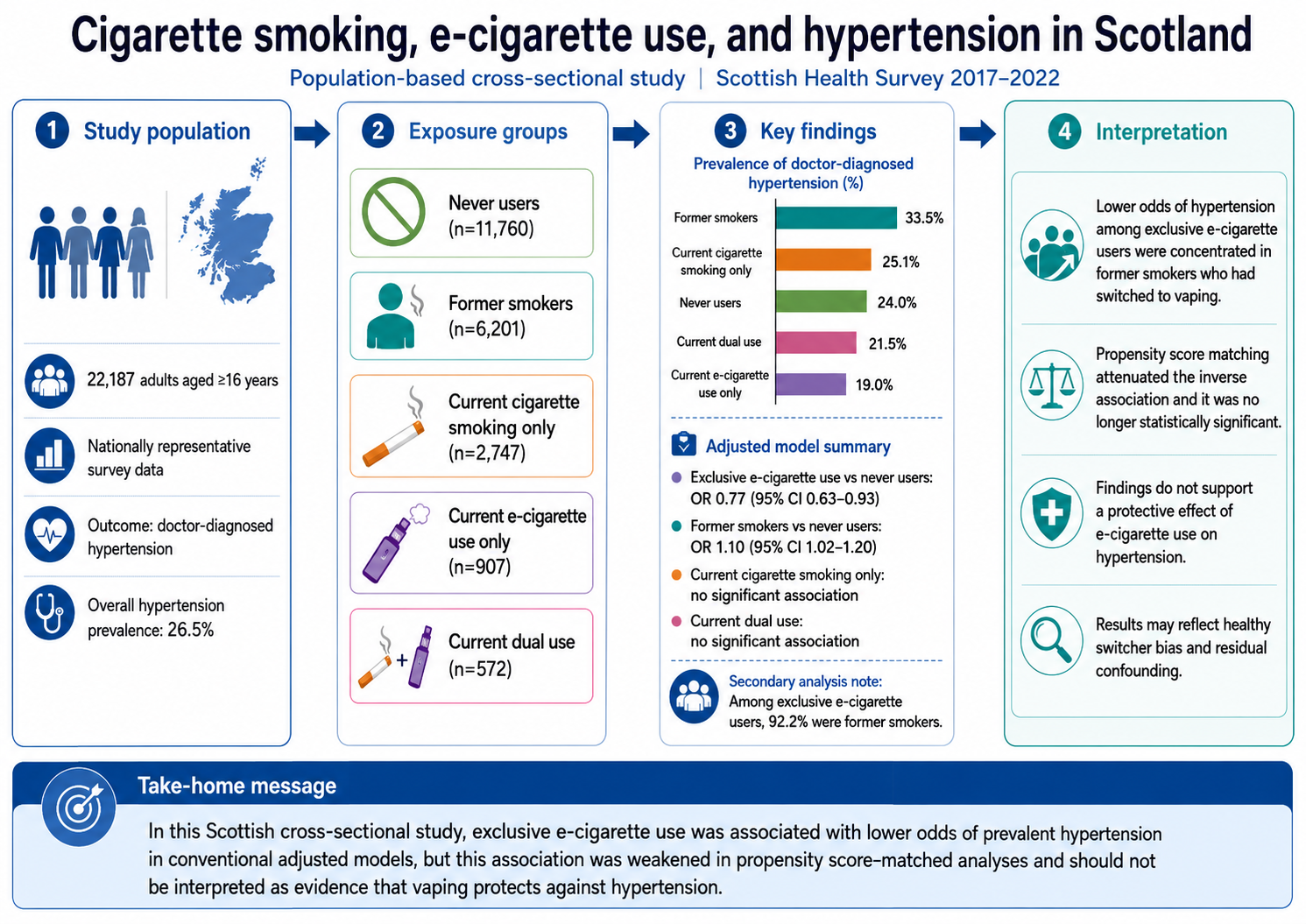
Why this study matters
E-cigarettes are increasingly used by adults, especially by people trying to stop smoking. In the UK, vaping is often discussed as a harm reduction tool for smokers who would otherwise continue using combustible cigarettes. However, nicotine can acutely increase heart rate and blood pressure, and there is still debate about the long-term cardiovascular effects of e-cigarette use.
This study was designed to help clarify whether adults who currently use e-cigarettes, smoke cigarettes, use both products, or use neither differ in their likelihood of reporting a diagnosis of hypertension.
What we studied
We analysed data from 22,187 adults aged 16 years and above who participated in the Scottish Health Survey between 2017 and 2022. Participants were grouped into five categories: never users of cigarettes or e-cigarettes; former smokers who did not currently vape; current cigarette smokers only; current e-cigarette users only; and dual users who currently smoked and vaped.
Hypertension was defined as self-reported doctor-diagnosed high blood pressure, excluding pregnancy-related hypertension. The analysis adjusted for important factors including age, sex, survey year, deprivation, education, ethnicity, diabetes, cardiovascular disease, alcohol use, and physical activity.
What we found
Overall, 26.5% of adults reported doctor-diagnosed hypertension. The prevalence differed across smoking and vaping groups. Hypertension was highest among former smokers and lowest among current exclusive e-cigarette users.
In the main adjusted analysis, current exclusive e-cigarette use was associated with lower odds of hypertension compared with never users. However, this finding must be interpreted very carefully. The lower odds were mainly seen among former smokers who had switched to vaping, not among dual users.
Importantly, when propensity score matching was used as a sensitivity analysis, the association between exclusive e-cigarette use and lower hypertension odds became weaker and was no longer statistically significant. This suggests that the finding may be partly explained by differences between groups, such as healthy switcher bias, residual confounding, body weight differences, or other unmeasured factors.
What the findings do not mean
The study does not show that vaping protects against high blood pressure. Because the data were cross-sectional, we cannot prove cause and effect. We also could not determine whether vaping started before or after hypertension diagnosis.
The findings should therefore not be used to claim that e-cigarettes reduce the risk of hypertension. A more cautious interpretation is that adults who had switched completely from smoking to vaping had lower observed odds of hypertension in standard models, but this pattern weakened after stronger adjustment for group differences.
The study does not show that vaping protects against high blood pressure. A more cautious interpretation is that adults who had switched completely from smoking to vaping had lower observed odds of hypertension in standard models, a pattern that weakened after stronger adjustment.
What about dual use?
Adults who both smoked and vaped did not have significantly lower odds of hypertension. This is important because it suggests that any possible health advantage is unlikely to come from vaping while continuing to smoke. Complete switching away from combustible cigarettes remains a key distinction in tobacco harm reduction research.
Why more research is needed
Future studies should follow people over time and use objective blood pressure measurements. They should also capture the following factors:
- Body mass index
- Duration of smoking
- Timing of smoking cessation
- Duration of e-cigarette use
- Nicotine strength and device type
- Whether people fully switch or continue smoking
Bottom line
This Scottish population-based study adds new evidence to the debate on e-cigarette use, smoking, and hypertension. Current exclusive e-cigarette users appeared to have lower odds of doctor-diagnosed hypertension in conventional adjusted models, especially former smokers who had switched to vaping. However, this association was not robust after propensity score matching and should not be interpreted as evidence that vaping prevents high blood pressure.
The key public health message is clear: smoking remains a major cardiovascular risk factor, dual use should not be assumed to reduce risk, and better longitudinal evidence is needed to understand the long-term cardiovascular effects of e-cigarettes.

Comments
Loading comments...
Leave a Comment
Share your thoughts on this article.