E-cigarettes are now used by millions of people worldwide, often as an alternative to combustible cigarette smoking. While much of the public debate has focused on respiratory and cardiovascular effects, less attention has been given to metabolic health. One important question is whether vaping is associated with prediabetes, diabetes, or insulin resistance.
A new systematic review and meta-analysis, published in Internal and Emergency Medicine, examined the available epidemiological evidence on e-cigarette use and glycaemic outcomes in adults. The review brought together data from 10 observational studies involving more than 2.8 million participants.
Association between electronic cigarette use and prediabetes, diabetes, and insulin resistance: a systematic review and meta-analysis
Read Full Paper →Why this question matters
Diabetes is one of the world’s major public health challenges. Type 2 diabetes often develops gradually, with many people first passing through earlier stages such as insulin resistance or prediabetes. These early metabolic changes may remain undiagnosed for years.
Cigarette smoking is already known to increase the risk of type 2 diabetes. Combustible cigarette smoke contains thousands of chemicals that may contribute to inflammation, insulin resistance, and pancreatic beta-cell dysfunction. E-cigarettes remove combustion, but many still deliver nicotine, and nicotine itself may plausibly affect insulin signalling and glucose regulation.
This makes the question complex. Are e-cigarettes linked to diabetes risk? Are any observed associations driven by vaping itself, by previous smoking, or by dual use of cigarettes and e-cigarettes?
What we did
We searched PubMed, Scopus, and Embase from database inception to December 2025. Eligible studies had to examine e-cigarette use in adults and report associations with diabetes, prediabetes, or insulin resistance.
Importantly, we separated different exposure groups where possible: current exclusive e-cigarette users, dual users who both smoked and vaped, and former e-cigarette users. This distinction matters because combining all e-cigarette users into one group can hide important differences, especially when many vapers are current or former smokers.
Ten studies met the inclusion criteria. Most were cross-sectional, meaning exposure and outcome were measured at the same time. Only one study was prospective, meaning it followed participants over time to assess incident type 2 diabetes.
What we found
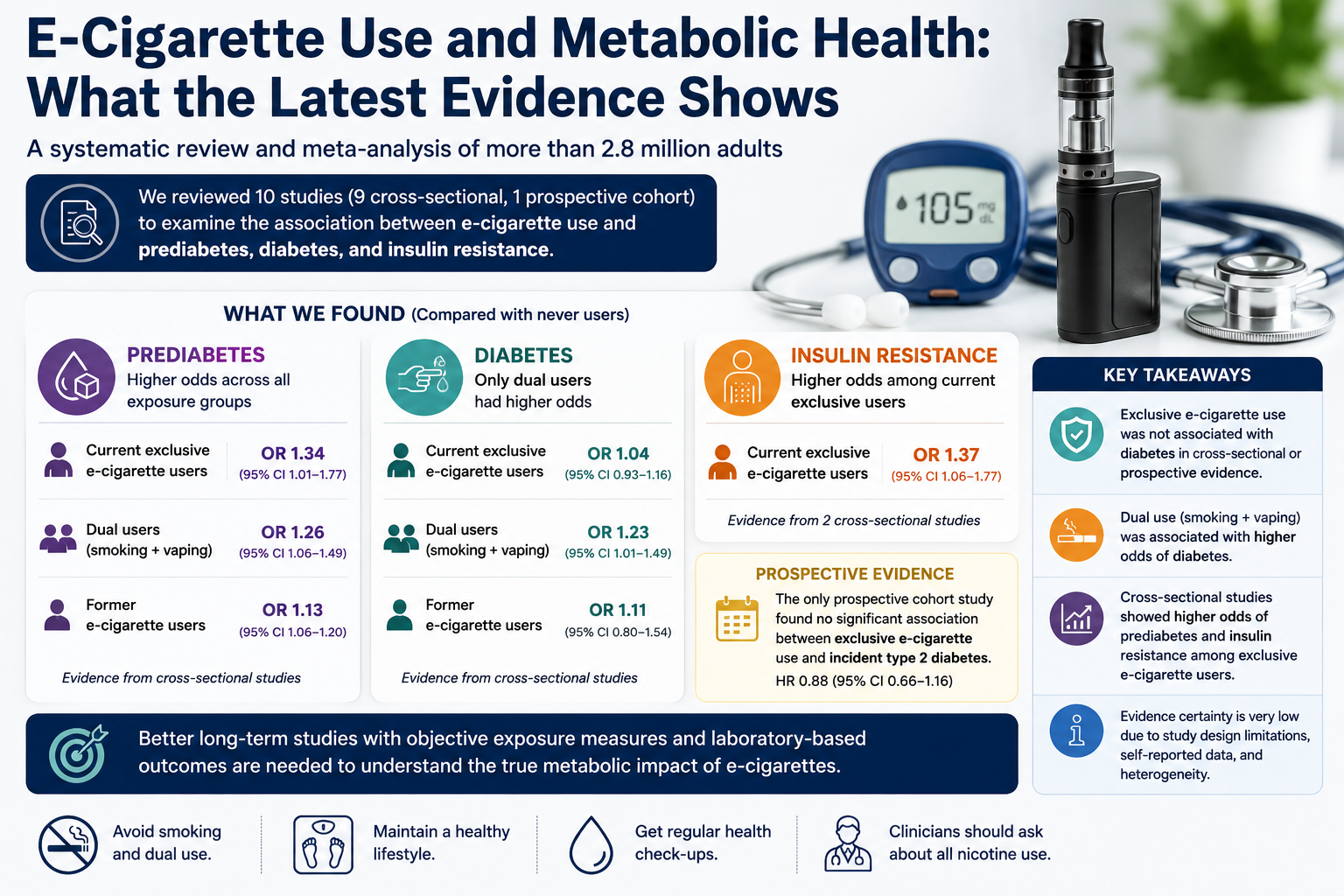
For prediabetes, current exclusive e-cigarette users had higher pooled odds compared with never users. Dual users and former e-cigarette users also showed elevated odds of prediabetes.
For insulin resistance, the pooled evidence suggested higher odds among current exclusive e-cigarette users compared with never users. However, this finding was based on only two studies, so it should be interpreted cautiously.
The evidence for diabetes was different. Current exclusive e-cigarette use was not significantly associated with diabetes in the pooled cross-sectional analysis. Former e-cigarette use was also not significantly associated with diabetes. The only group with significantly higher odds of diabetes was dual users.
The only prospective cohort study found no significant association between exclusive e-cigarette use and incident type 2 diabetes over about four years of follow-up. In the same study, cigarette smoking was associated with increased diabetes risk.
What the findings mean
The evidence does not show a clear independent association between exclusive e-cigarette use and clinical diabetes. This is an important finding because diabetes is the most clinically consequential outcome examined in the review.
Exclusive e-cigarette use was not associated with diabetes in either cross-sectional or prospective evidence. The one group with significantly higher odds of diabetes was dual users.
However, the elevated cross-sectional associations with prediabetes and insulin resistance should not be ignored. They may indicate early metabolic changes, but they may also reflect reverse causation, residual confounding, or behavioural differences between groups.
For example, people with metabolic risk may stop smoking and switch to vaping after health concerns emerge. In that case, vaping may appear associated with prediabetes because people at higher risk are more likely to change their nicotine use behaviour. Dual users may also have higher nicotine dependence, poorer diet, lower physical activity, or other risk factors that are difficult to fully adjust for.
Why caution is needed
The certainty of evidence was rated very low across outcomes. Most studies were cross-sectional, e-cigarette use was self-reported, and many outcomes were based on self-reported diagnosis rather than laboratory testing. Studies also differed in how they defined never users, current users, former users, and dual users.
These limitations mean the findings should be interpreted as associations, not proof that vaping causes or prevents diabetes.
Bottom line
This systematic review and meta-analysis found that exclusive e-cigarette use was not associated with diabetes in either cross-sectional or prospective evidence. Dual use was associated with higher odds of diabetes, which may reflect continued exposure to combustible cigarettes and related behavioural risk factors. Cross-sectional evidence also linked e-cigarette use with prediabetes and insulin resistance, but these findings cannot establish causality.
Future research should use large prospective cohorts, objective biomarkers of smoking and vaping exposure, and standardised laboratory-based glycaemic outcomes. Until stronger evidence is available, studies and clinical discussions should continue to distinguish exclusive vaping from dual use.

Comments
Loading comments...
Leave a Comment
Share your thoughts on this article.