
Stopping cigarette smoking is one of the most important steps a person can take to improve their health. The benefits of quitting begin quickly and continue to grow over time, reducing exposure to the toxic chemicals produced by combustible tobacco. But an important question remains: what happens to perceived health among people who quit smoking but continue using e-cigarettes?
Our new study, published in the Irish Journal of Medical Science, examined the relationship between time since cigarette smoking cessation and self-rated health among current e-cigarette users who were former smokers in Scotland.
Time since cigarette smoking cessation and self-rated health among exclusive e-cigarette users
Read Full Paper →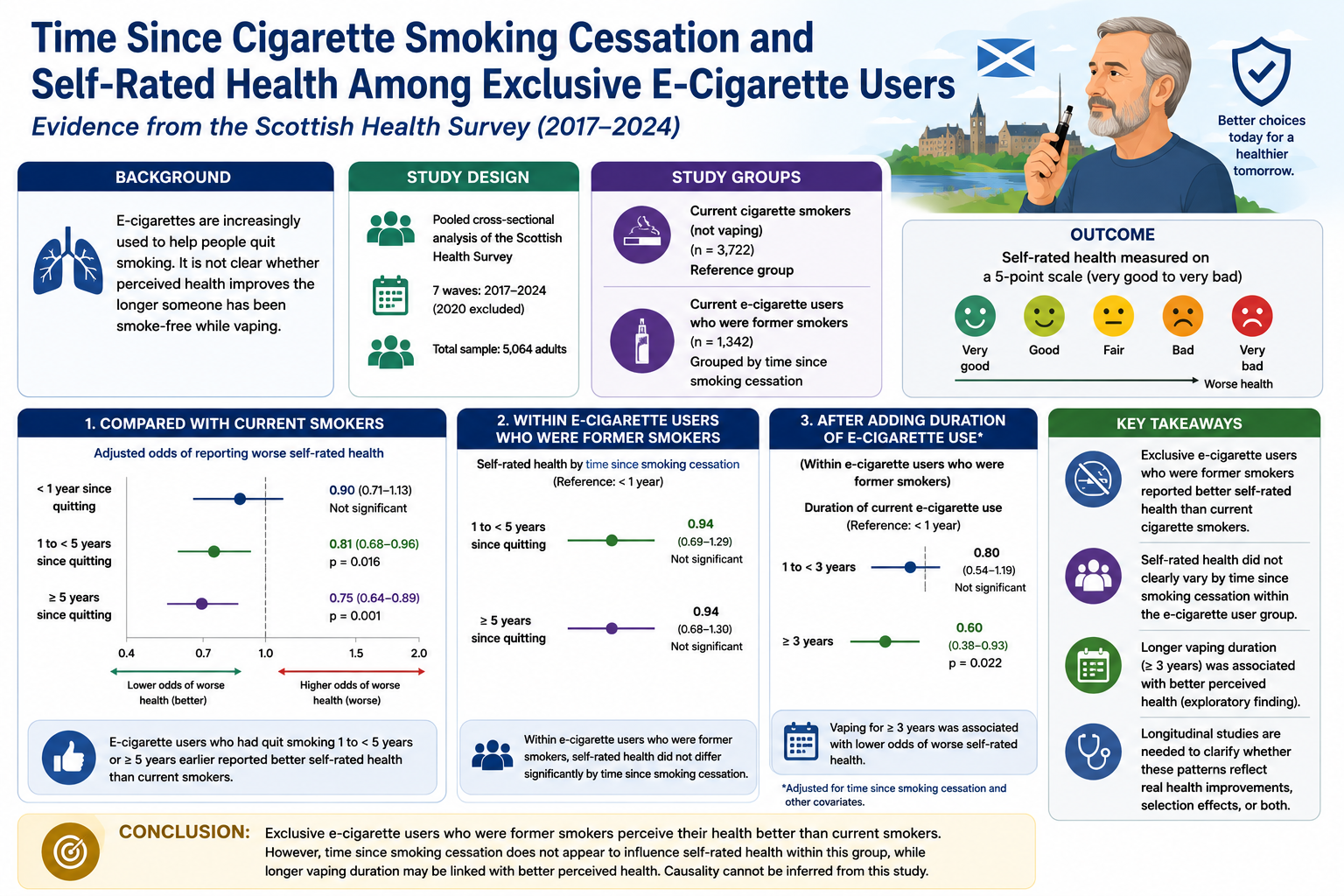
Why this study matters
E-cigarettes are increasingly used by people trying to stop smoking. In the UK, vaping is commonly discussed as a harm reduction option for adults who smoke and are unable or unwilling to quit nicotine completely. E-cigarettes are not risk-free, but they do not involve tobacco combustion, which is the main source of the most harmful toxicants in cigarette smoke.
Previous studies have shown that exclusive e-cigarette users often report better self-rated health than current cigarette smokers. However, less is known about whether perceived health differs according to how long ago a person stopped smoking, especially among people who currently vape.
This matters because time since smoking cessation is important. Someone who quit smoking five years ago may have a different health profile from someone who quit a few months ago. Understanding these patterns can help clinicians, researchers, and public health professionals interpret vaping-related health findings more carefully.
What we studied
We analysed data from seven waves of the Scottish Health Survey between 2017 and 2024, excluding 2020 because survey collection was disrupted by the COVID-19 pandemic.
The study included 5,064 adults. These were current cigarette smokers who were not currently vaping, and current e-cigarette users who were former smokers. The e-cigarette users were grouped according to how long ago they had quit smoking: less than one year, one to less than five years, and five years or more.
The main outcome was self-rated health, measured from very good to very bad. The analysis adjusted for age, sex, ethnicity, area deprivation, limiting long-standing illness, and survey year.
What we found
Compared with current cigarette smokers, exclusive e-cigarette users who were former smokers generally reported better self-rated health.
In the fully adjusted model, e-cigarette users who had quit smoking one to less than five years earlier had lower odds of reporting worse self-rated health than current smokers. Those who had quit five years or more earlier also had lower odds of worse self-rated health.
The group who had quit less than one year earlier showed a similar direction, but the association was not statistically significant. This may partly reflect the smaller number of people in that group.
These findings suggest that former smokers who currently use e-cigarettes may perceive their health more favourably than people who continue to smoke cigarettes.
What happened within the vaping group?
A key part of the study looked only at current e-cigarette users who were former smokers. Within this group, self-rated health did not clearly differ according to time since smoking cessation.
In other words, among people who had already switched from smoking to vaping, those who quit smoking longer ago did not report clearly better self-rated health than those who quit more recently.
The study also explored duration of current e-cigarette use. Longer vaping duration of three years or more was associated with better self-rated health, but this finding should be treated cautiously. Time since smoking cessation and duration of vaping were closely related, so the analysis could not clearly separate the two.
What the study does not prove
This study does not prove that vaping improves health. It was cross-sectional, meaning exposure and health status were measured at the same time. People in better health may be more likely to quit smoking successfully, while people with poorer health may have different patterns of smoking, quitting, or vaping.
The study also could not adjust for important details such as pack-years, smoking intensity, vaping frequency, nicotine concentration, device type, diet, physical activity, alcohol use, or mental health.
Bottom line
Current e-cigarette users who had previously smoked reported better self-rated health than current cigarette smokers in Scotland. However, among e-cigarette users themselves, self-rated health did not clearly vary by time since smoking cessation.
The findings are consistent with the possibility that moving away from combustible tobacco is associated with better perceived health. But they should not be interpreted as proof that vaping causes better health. Longitudinal studies with objective health measures are needed to clarify whether these patterns reflect real health improvements, selection effects, or both.

Comments
Loading comments...
Leave a Comment
Share your thoughts on this article.